Fundamentals
The 8% Flat Income Tax Rate Explained for Filipino Freelancers
6 min read
Short version: the 8% flat income tax rate lets a self-employed Filipino pay a single 8% on gross receipts above ₱250,000 for the year, instead of the graduated income tax (0–35%) plus the 3% percentage tax. No expense receipts, no audited statements. This guide covers who qualifies, how the ₱250,000 exemption works, and how to elect the rate.
If you want the 60-second version, read what the BIR 8% income tax rate is first — this article is the fuller walkthrough.
Freelancing was supposed to buy you time, not a second job doing tax arithmetic. The 8% flat rate is the part of the Philippine tax system that actually works in a freelancer's favour: one rate, one formula, predictable every quarter.
General information, not tax advice. Based on the TRAIN Law (RA 10963), Revenue Regulations No. 8-2018, and the BIR's income tax guidance. Rules change — confirm your case with your RDO.
What the 8% flat income tax rate actually is
Before the TRAIN Law, a self-employed professional paid tax twice: a 3% percentage tax every quarter (BIR Form 2551Q) and the graduated income tax (0–35%) on net income at year-end, which meant tracking every deductible expense.
The 8% flat income tax rate collapses both into one. Elect it and you pay a flat 8% on your gross sales or receipts above ₱250,000 for the year — nothing else. You file only the quarterly (1701Q) and annual (1701A) income tax returns; the 3% percentage tax and Form 2551Q go away.
"Gross" means the full amount your client agreed to pay, before platform or bank fees — you do not net out Upwork's cut or PayPal charges. In exchange for that simplicity, the BIR ignores your business expenses entirely. See the 8% rate versus graduated rates if you think heavy expenses might make itemising worth it.
Who can use the 8% rate
You can elect the 8% rate if all of these hold:
- You are non-VAT registered. The 8% option is for non-VAT taxpayers only.
- Your gross receipts stay at or below ₱3,000,000 for the year — the VAT threshold. Go above it and you move to the graduated rates and register for VAT (the ₱3,000,000 limit, explained).
- You are purely self-employed or a professional — freelancers, virtual assistants, content creators, consultants, sole proprietors. Partners in a general professional partnership are excluded.
- You elected it in time (see below). The BIR never applies it automatically.
Mixed-income earners — a salaried job plus a side hustle — can still use 8% on the freelance income, but the ₱250,000 exemption does not apply, because it is already built into salary withholding. How mixed income works.
How the ₱250,000 exemption works
For a purely self-employed person, the first ₱250,000 of income each year is tax-free. You apply 8% only to what exceeds it.
Gross receipts for the year:      400,000
Less: annual exemption            -250,000
Taxable amount:                    150,000
Income tax due (8%):               12,000
Two things people get wrong:
- The exemption is annual, not quarterly. You do not get ₱250,000 tax-free every quarter — it is ₱250,000 for the whole year, and once you have used it up, later quarters are taxed from the first peso. More on the ₱250,000 exemption.
- Income tax is cumulative. Each 1701Q looks at your year-to-date total, computes the tax on that, and subtracts what you already paid in earlier quarters.
What you stop doing on the 8% rate
- No itemised deductions. No keeping receipts for internet, a laptop, or coffee-shop meetings to lower a tax bill.
- No Form 2551Q. The quarterly percentage tax return is gone.
- No audited financial statements. 8% filers are exempt from the CPA-audited financial statement requirement.
- No year-end surprises. Set aside 8% of every payout above the exemption and the quarter is covered.
How to elect the 8% rate
You signal the election in one of two places:
- At registration — tick the 8% option on BIR Form 1901 when you first register with your RDO. Not registered yet, or registered only as an employee? RaketTax Launchpad can handle the whole registration (or the update under your existing TIN), election included, without an RDO visit.
- On your first quarterly return of the year — choose "8% income tax rate" on the Q1 1701Q, filed on or before May 15. If your Certificate of Registration still lists Percentage Tax, do one more thing first: file Form 1905 in ORUS early in the year, before April 25, to remove it. If it is not removed in time, still file the Q1 2551Q with zero tax and a note that you chose 8%.
The election is irrevocable for that taxable year. If you choose 8% in the first quarter, you use it for all of that year; you can only switch back to graduated rates starting the next year. Miss both windows and the BIR defaults you to graduated rates plus the 3% percentage tax for the year.
You choose 8% again every year. Each year, your first-quarter 1701Q (due May 15) is where you select the 8% rate again. Tick 8% on it and file it on time: it is the most important return of your year.
Making the 8% rate even easier
Even a one-line formula has to land in the right boxes on 1701Q and 1701A, in the right quarter, with the cumulative math carried forward. A single mis-checked box or a skipped quarter is what turns a simple return into an open case.
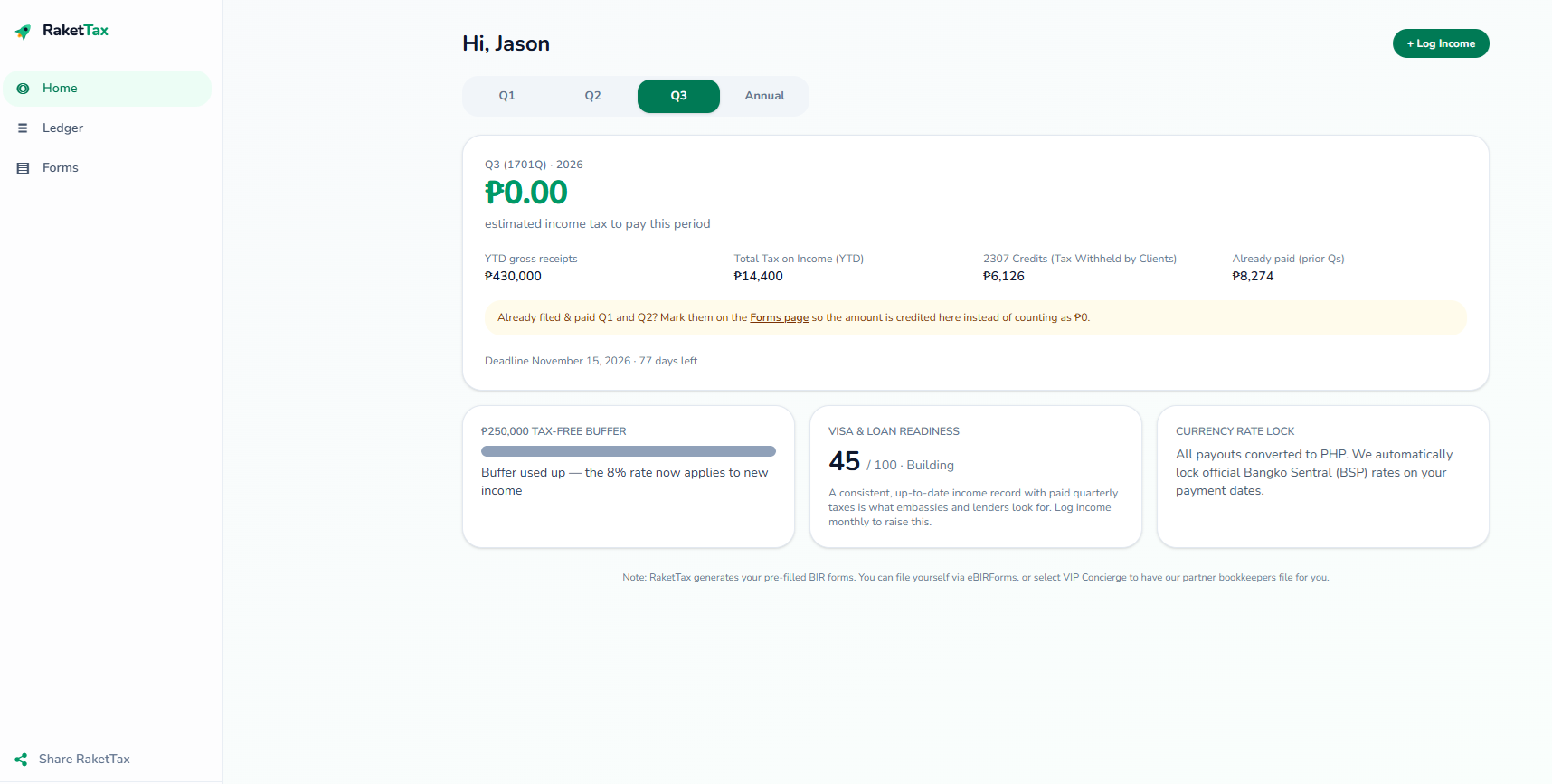
That is what RaketTax handles. You log what each client paid you; it applies the ₱250,000 exemption in the correct quarter, carries your running totals across the year, computes the 8% due, and produces the 1701Q or 1701A to match. Then you either file it yourself through eBIRForms, or send it to the RaketTax VIP Concierge — you approve the return and a partner bookkeeper files it with the BIR for you. Tracking your income is free — freelancers and small business owners on the 8% rate pay only when a return is filed.
Frequently asked questions
Do I still need to file percentage tax if I choose the 8% rate?
No. The 8% flat rate replaces the 3% percentage tax. You file only the quarterly (1701Q) and annual (1701A) income tax returns — no more Form 2551Q.
Can I switch back to graduated rates later?
Yes, but only at the start of the next taxable year. Once you elect 8% on your first-quarter return, it is locked for the rest of that year.
What if my freelance income crosses ₱3,000,000 mid-year?
You lose the 8% rate. You update your BIR registration to VAT, shift to the graduated income tax rates, and become liable for the 3% percentage tax for the year. The 8% you already paid is credited against your income tax, so it is not lost. See the ₱3,000,000 limit.
How do I tell the BIR I want the 8% rate?
New registrants tick the 8% box on Form 1901. If you are already registered, choose "8% income tax rate on gross sales/receipts" on your first-quarter 1701Q, filed on or before May 15. If Percentage Tax is on your COR, file Form 1905 in ORUS before April 25 to remove it first.
Ready to stop stressing over the BIR?
RaketTax tracks your income for free and fills in your 1701Q and 1701A so you can review the numbers before you file.
Create my FREE RaketTax account